

However, many people with disabilities continue to face barriers in accessing online content; it is enough to consider that 95% of websites are not accessible.
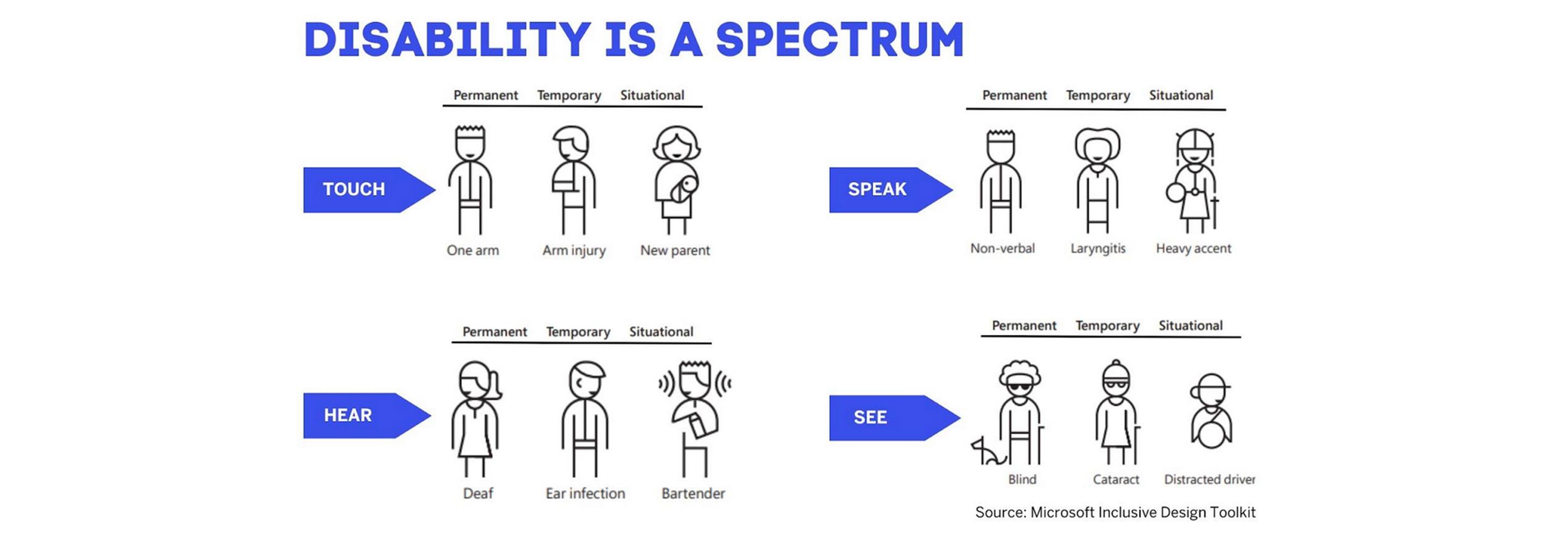
Digital accessibility concerns the design and development of websites, applications, and digital content that can be easily used and understood by people with disabilities. This includes individuals with hearing, visual, motor, cognitive impairments or other types of disabilities, but in general, it concerns everyone as a disability can be permanent, but also temporary (such as in the case of injuries) or linked to particular situations or circumstances one finds oneself in at a specific moment.
Without adequate accessibility, these people risk being excluded from digital participation, thus limiting their access to information, education, employment, and social participation.
Digital accessibility today
Today, the reference directive is the Web Accessibility Directive (WAD) which, at the European level since 2016 (transposed in Italy only a few years later), aims to make public sector websites and mobile applications more accessible and unify the various standards across the EU.The directive states that all public bodies must have accessible websites and apps; they must also have an accessibility statement to communicate what is not fully accessible.
They must also provide a feedback mechanism, meaning an accessible way to allow users with disabilities to report any issues, as well as the obligation to intervene following reports to resolve the accessibility problem.
Digital accessibility in the near future
From next June 2025, with the introduction of the European Accessibility Act (EAA), web accessibility will truly be an obligation for all: the law provides that all new digital products placed on the market (hardware, software, hybrids) must be accessible.Only one exemption is provided for products already on the market, which requires adaptation by June 2030. It is therefore essential to move forward in advance and not wait; we have the responsibility and the duty to guarantee the service for which that product was developed (for example, if I have a booking site and it is not accessible, the user with a disability could feel discriminated against and sue the company that provided the inaccessible service).
Accessible Websites
Developing websites that are accessible means following specific guidelines published by the W3C under the name of Web Content Accessibility Guidelines (WCAG), the latest version of which is 2.2 from October 5, 2023.These guidelines include:
- global principles (i.e., the four principles that serve as pillars of Web accessibility: perceivable, operable, understandable, and robust);
- general guidelines (13 guidelines that provide the basic objectives to work on to make content more accessible to users with disabilities);
- verifiable success criteria;
- sufficient and recommended techniques, as well as documentation on the most common errors .
To be more concrete, some examples of guidelines provide for:
1. Logical Structure: use appropriate semantic markers (such as HTML5) to ensure a logical and orderly structure of the content.
2. Alternative Text: provide alternative text for images so that blind users or those with visual impairments can understand the content.
3. Contrast: ensure there is adequate contrast between the text and the background to promote readability.
4. Intuitive Navigation: use a clear and consistent navigation architecture to allow users to easily find what they need.
5. Accessible Multimedia Content: provide subtitles for videos and audio descriptions for people with hearing disabilities.
6. Accessible Keyboard: ensure that all site functionalities can be used via the keyboard for those who cannot use a mouse.
It must also be clarified that there are no tools or plugins (such as so-called Accessibility Overlays) that automatically and totally solve the accessibility problem, but technical intervention on the application is always necessary at the back-end, front-end, and content levels to make it accessible.
It is also necessary to provide continuous testing by users with disabilities (who therefore use support tools for their disabilities such as screen readers) as the automatic checks available online can only give a partial indication of the level of accessibility.
The development of an accessible website does not end even when the product is delivered, as, especially for self-managed sites such as e-commerce, it is necessary to train the people who will manage the content so that they respect certain rules, otherwise the website will no longer be compliant (as one of the principles of accessibility says: not only the container (site, app, ..) is important, but also the content).
Conclusions
The Glacom development team, as well as designers and content creators (because accessibility concerns all phases of the work), recently participated in the Accessibility Days event and several preparatory webinars held in the preceding days to stay updated on this topic and on the continuous developments regarding the entry into force of the EAA.Staying updated and implementing accessible solutions allows for expanding one's audience, improving the user experience, and promoting inclusivity. In an increasingly digital world, it is fundamental to guarantee everyone, regardless of individual abilities, the access and use of online resources in an autonomous and easy manner. Glacom has chosen to invest in the accessibility of its products, concretely committing to a more inclusive and sustainable digital future for all.
To learn more, we invite you to read this very practical article: https://www.glacom.it/blog-it/Accessibilità-digitale-cosa-dobbiamo-fare-veramente-560.html