
What is a 3D viewer?
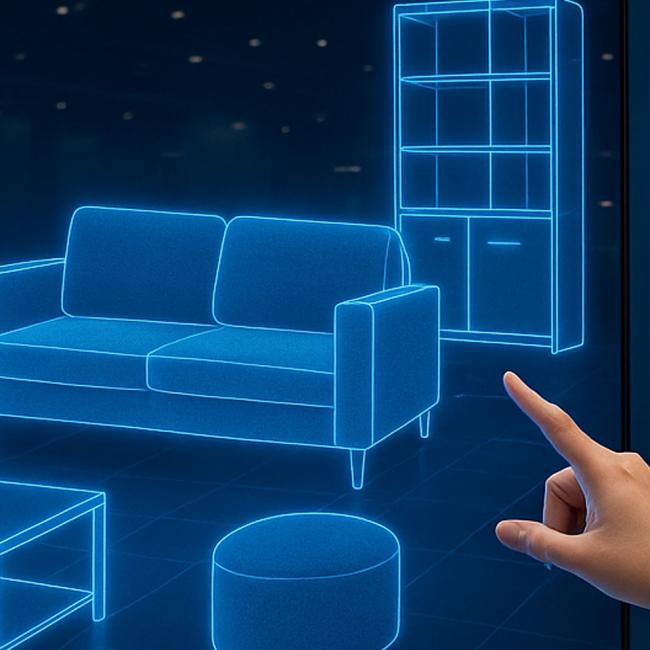
A 3D viewer is an interactive web-accessible tool that allows you to explore a three-dimensional model directly from the browser, without the need for external software. The user can rotate, zoom, explode, or assemble the object, observing every detail from multiple angles. In some advanced versions, it is also possible to customize the product, choose variants, simulate combinations, or interact with technical content (data sheets, measurements, materials). Increasingly, these tools also integrate augmented reality (AR) functionality, which allows the user to visualize the product in their own physical space, through a smartphone or tablet camera. An immersive experience that merges the real and the virtual, very useful for evaluating the size of an object, its placement in an environment, or simply to showcase it in a more engaging way.
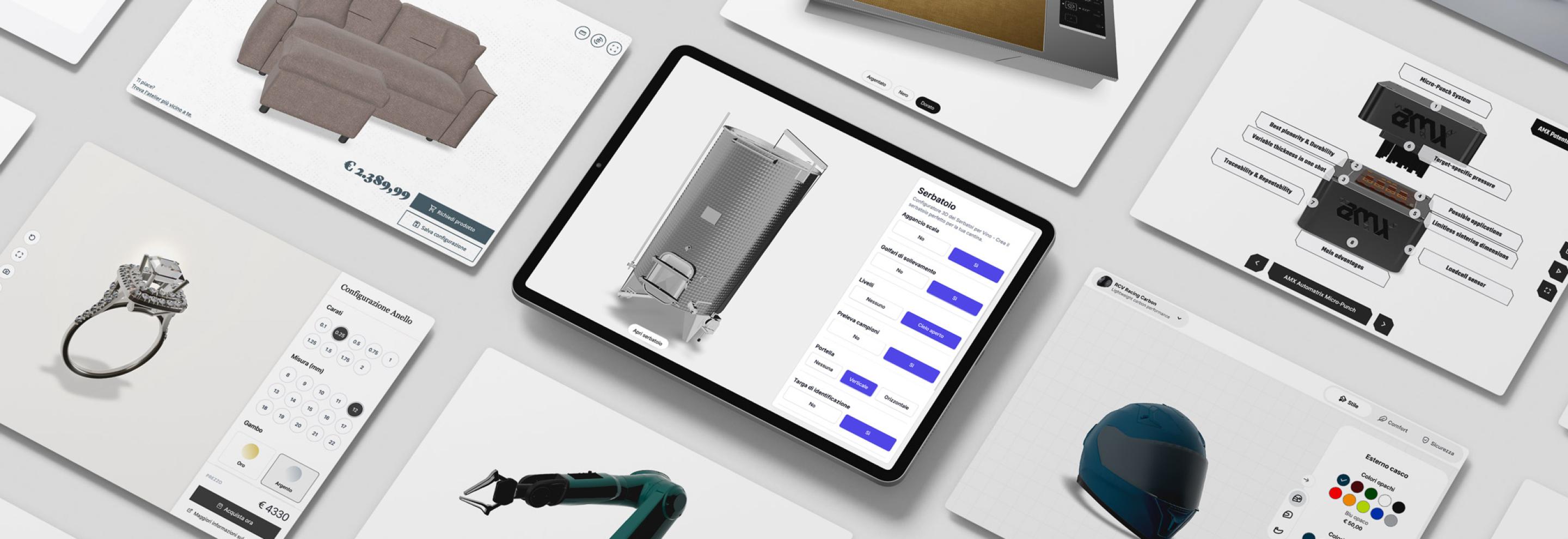
↑ This is an example of a 3D viewer. Try interacting with the 3D model!
Fields of application
3D viewers are used in a variety of sectors, both industrial and commercial:-
Mechanical and manufacturing industry
Ideal for showing complex components, plants, modular systems, or custom products, which are often difficult to describe with traditional photos or diagrams. -
Furniture and interior design
Useful for visualizing customized environments, design elements, configurable furniture, and architectural solutions. Integration with AR allows "inserting" a piece of furniture or a kitchen directly into the customer's room. -
Fashion and accessories
They allow the exploration of accessories such as glasses, watches, shoes, or bags in 3D, with the possibility of simulating colors, materials, or custom engravings - even trying them on virtually via AR. -
Construction and plant engineering
They offer a three-dimensional and contextual view of electrical, plumbing systems, or prefabricated structures, even during the design phase or on site. -
Training and technical assistance
Used for training, interactive manuals, or assembly and maintenance simulations, they reduce learning times and improve understanding.
↑ This is an example of a 3D viewer with basic configuration options. Try it now!
Why adopt a 3D viewer?
Beyond the visual impact and perceived modernity, 3D viewers offer concrete advantages:- Clearer communication: they help the user immediately understand the product's characteristics, even without a technical background.
- Immersive experience: interaction improves engagement and stimulates interest, increasing the time spent on the site or platform.
- Integrated augmented reality: the ability to visualize the product in the user's real space strengthens the perception of value, reduces uncertainty, and accelerates the decision-making process.
- Reduction of errors: visually showing variants and configurations helps gather more accurate requests and simplifies the work of the sales department.
- Versatility of use: viewers are suitable for many contexts, from trade fairs to digital showrooms, from internal training to B2B negotiations.
- Seamless integration: they can be connected to CRM, eCommerce, configurators, quoting tools, and corporate systems to create consistent workflows.
A natural evolution of product communication
Today, 3D visualization - supported by augmented reality - is no longer the exclusive domain of large multinationals or hi-tech sectors. With the evolution of web technologies and the spread of high-performance devices, these tools have become accessible and scalable, adaptable to different types of businesses and products. Unlike a static rendering or a digital brochure, a 3D viewer provides a sense of concreteness, reduces abstraction, and leads the user to interact actively. And when a potential customer interacts, informs themselves, and experiments - they are much closer to a decision.Difference between 3D viewer, 3D configurator, and augmented reality
When talking about interactive product presentation, terms like 3D viewer, 3D configurator, and augmented reality are often used together, but they refer to tools with different functions.A 3D viewer allows the user to observe a three-dimensional product from multiple viewpoints. It is ideal when the main goal is to show the shape, proportions, construction details, and aesthetic or technical characteristics of an object.
A 3D configurator adds a further level: it allows the product to be customized in real time, choosing colors, materials, finishes, accessories, dimensions, or components. It is particularly useful for modular, customizable products or those available in many variants.
Augmented reality, on the other hand, allows the 3D model to be visualized within a real space, via smartphone or tablet. This function is very effective for furniture, machinery, design objects, technical components, or any solution where it is important to evaluate size, proportions, and placement in the environment.
In many digital projects, these tools can coexist: the 3D viewer presents the product, the configurator allows for customization, and augmented reality helps the customer imagine it in their own real context.