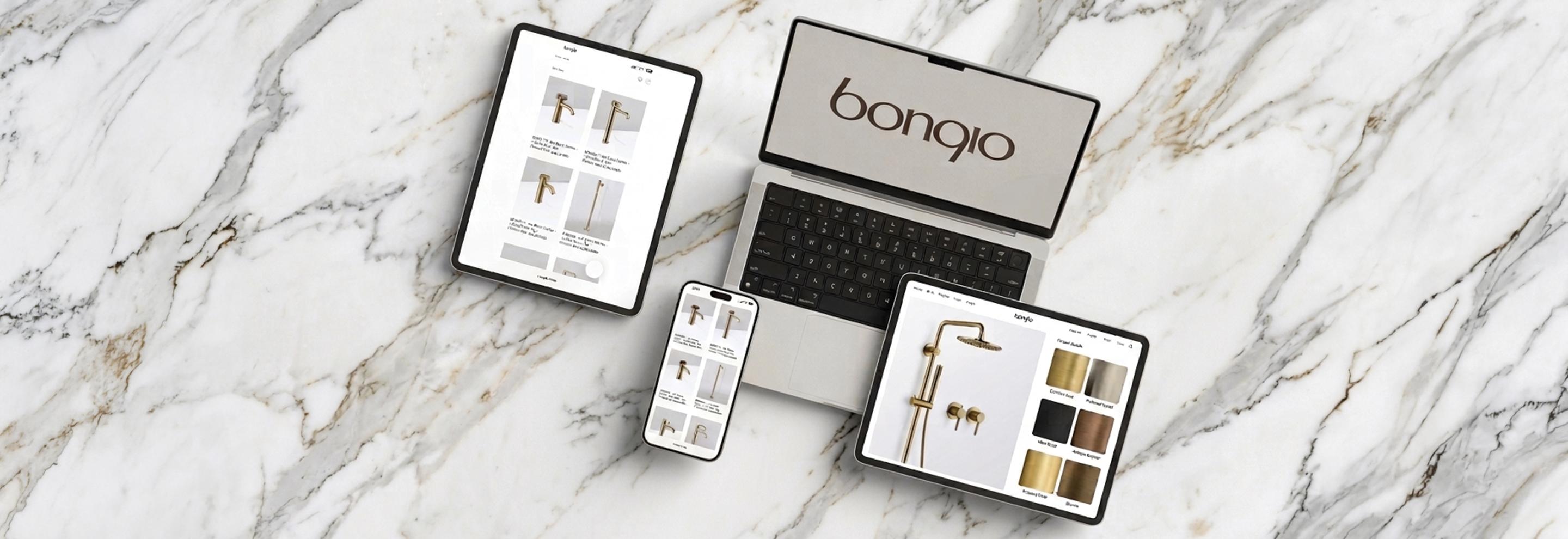

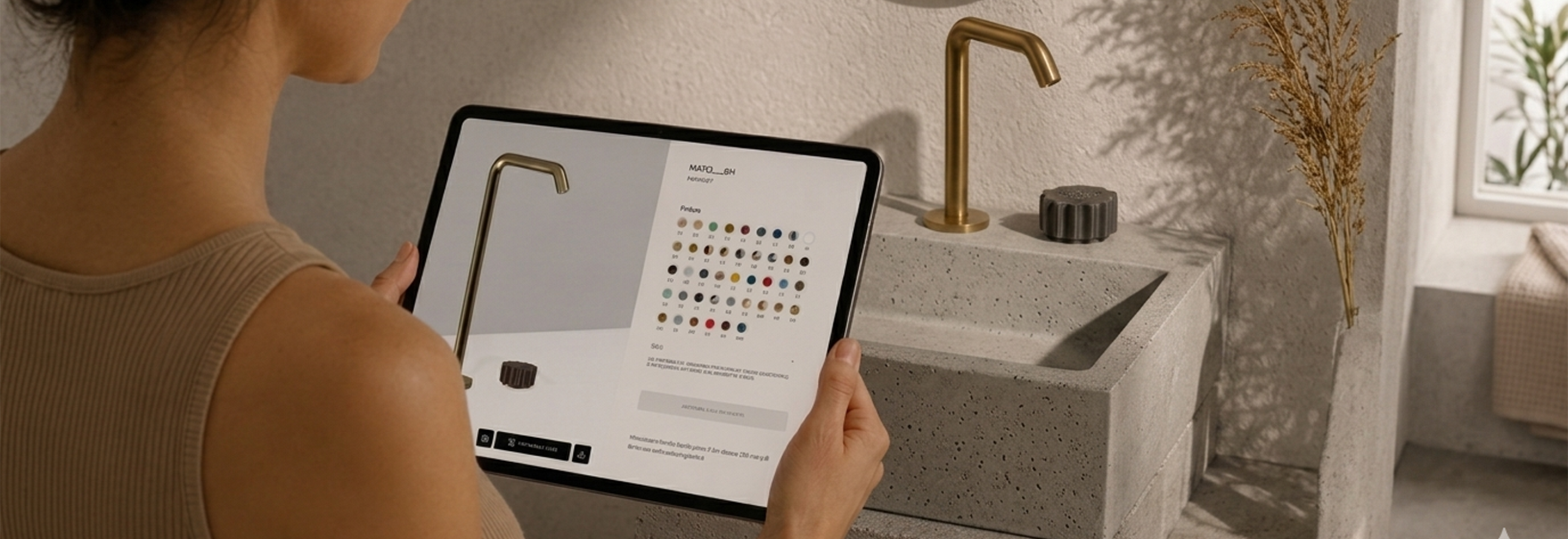
From this need comes the real-time 3D configurator that we created for Bongio: a digital tool integrated directly into the company's website, designed to allow the user to customize faucets by choosing from the available finishes and viewing the result in real time.
A configurator integrated into the site and the sales process
The goal of the project was not simply to show a 3D model, but to create a tool truly integrated into the Bongio digital ecosystem.The configurator allows the user to change the texture of the faucet by choosing from the finishes available for that specific product. Each selection is applied directly to the 3D model, offering an immediate and realistic representation of the final result.
The experience does not stop at visual configuration alone: the user can also view the faucet in augmented reality directly in their own environment, download the configured 3D model, or generate a screenshot of the chosen configuration, useful for saving, sharing, or using as a reference.
This functionality takes on even greater value when placed within a large and complex catalog consisting of approximately 2,000 products. In such a context, manually managing images, renders, and variants for every possible combination would have required extremely laborious work, both in the content production phase and the site update phase.
The configurator, instead, allows for the centralization of the customization experience, making every variant available in a dynamic, consistent, and always updated manner.
Shopify Integration: always consistent finishes and combinations
One of the most important features of the project is the integration with Shopify.The possible finishes and available combinations are not managed manually within the configurator, but derive directly from the data present in the shop. The configurator intercepts the user's choice and applies the correct finish to the 3D model in real time.
This approach ensures consistency between the site, product, availability, and visual configuration. If a certain finish or combination is managed in Shopify, the configurator can receive the information and translate it into an interactive experience.
The advantage is twofold: on one hand, the user always has a faithful representation of the options actually available; on the other, the company avoids operational duplication and reduces the risk of inconsistencies between the catalog, site, and configurator.
Backend integration for always updated product data
The integration with Shopify did not stop at the visual part of the user interface; in fact, the configurator was also connected to the Shopify backend to retrieve all product-related information.This ensures that data is always updated and aligned with the company system: product sheets, variants, technical information, and content can be managed centrally, without having to manually intervene on multiple platforms.
For a company with such an extensive catalog, this aspect is fundamental. The configurator is not an isolated element, but a component integrated into a broader digital infrastructure, designed to grow alongside the catalog and support the evolution of the offering over time.
Our work on 3D models and textures
From a technical point of view, we handled the optimization of the 3D models and the creation of textures, with the goal of ensuring a balance between visual quality, realism, and web performance.Every material must be believable, lightweight, and suitable for real-time visualization. This requires meticulous work on textures, surface rendering, and overall asset optimization, so that the configurator remains fluid even within a website and usable across different devices.
In the faucet sector, the finish is not a secondary detail: it is an essential part of the product perception. Chrome, brass, matte black, brushed effects, and other finishes radically change the character of the faucet and must therefore be represented with precision.
The configurator allows these variants to be shown immediately, enhancing Bongio's design and helping the user better understand the final effect of their choice.
Automated generation of flexible hoses in 3D models
Another relevant technical activity involved the development of a functionality for the automated generation of flexible hoses within 3D models that lacked them, as in the case of some shower sets.This is a significant intervention because it allows for the completion and standardization of 3D models without having to manually rebuild every element for every product. In this case as well, automation reduces processing times, increases visual consistency, and makes the management of a very large catalog scalable.
The result is a more complete configurator, capable of representing the product realistically and consistently even when the starting model does not contain all the necessary components.

The problem solved: avoiding thousands of shots and renders
Before the introduction of the configurator, showing every product in every finish would have required taking photographs or creating renders for all possible combinations, then uploading them manually to the website.With approximately 2,000 products and numerous available finishes, this process would have involved an enormous amount of content to produce, manage, update, and archive.
The 3D configurator solves this problem at the root: there is no need to generate a static image for every variant, because customization happens directly on the 3D model. The user chooses the finish and the system applies it in real time.
This means greater efficiency for the company, greater flexibility in catalog management, and a more engaging experience for those browsing the site.
A tool for retailers as well
The configurator is not designed only for the end customer. It will also be used by retailers, who access the system via login and can view dedicated information, including prices and confidential data.In this way, the tool becomes a concrete sales support: the retailer can show the product, change finishes together with the customer, verify available options, and work on a clearer and more immediate configuration.
The screenshot and 3D model download functions also become practical tools to accompany quotes, presentations, and project materials.
3D visualization helps reduce doubts and misunderstandings, making the dialogue between the company, retailer, and end customer simpler. The configurator thus becomes not only a communication tool but also a commercial asset.
Presented at Salone del Mobile 2026
The Bongio configurator was presented on the occasion of the Salone del Mobile 2026, one of the most important international events for the world of design, furniture, and interiors.In a trade fair context, a tool of this type allows for the immediate demonstration of the catalog's depth and customization possibilities, even when it is not possible to physically exhibit every product variant.
The visitor can interact with the faucet, change the finish, explore combinations, and understand the design value of the Bongio proposal in a few seconds.
Technology, design, and commercial process in a single tool
The real-time 3D configurator created for Bongio represents a concrete example of how technology can enhance design and, at the same time, simplify complex processes.On one hand, it improves the user experience, making the choice more intuitive, visual, and engaging. On the other, it supports the company and the sales network in managing a large, complex catalog rich in variants.
Thanks to the integration with Shopify on both the front-end and back-end, the optimization of 3D models, the dynamic management of finishes, and features such as augmented reality, screenshots, and 3D model downloads, the configurator becomes a scalable, updated tool perfectly embedded in the Bongio digital process.
A project that combines aesthetics, functionality, and innovation, transforming faucet customization into an interactive, immediate, and truly useful experience for customers, designers, and retailers.
Where to find it? On all pages of the website: https://www.bongio.com/